

The Industrial B2B Growth Playbook
Most Founders Have the Pieces. Nobody Told Them How They Fit.
A manufacturing facility owner spends Monday morning sending cold emails from Outlook. On Tuesday, he updates a spreadsheet that passes for a pipeline. On Wednesday, he runs a LinkedIn ad because someone told him he should. By Thursday, he has no idea which of these activities is working, which is wasting time, and whether any of it will produce revenue next month.
Reliable growth comes from having a framework in place. And he's simply working without a framework. His hard work won't reliably produce results. The real difference between a business that grows predictably and one that grows by accident is the framework and systems.
This article is an overview of working architecture. It maps what a complete B2B growth strategy looks like for an industrial SMB, recaps the three systems we covered in previous articles, and introduces four areas that will be covered in the next articles.
Why Most B2B Growth Efforts Underperform
The pattern is consistent across industrial SMBs, CNC shops, manufacturing firms, automation integrators, equipment suppliers, and mechanical engineering companies. They are not short of ambition or capability. What they are short of is a connected system.
Most founders run three to five growth activities simultaneously: some outreach, some ads, some content, some events. Each activity produces some result. But because none of them are connected, the founder cannot differentiate the impact on revenue.
The other consistent pattern is when founders try to run ads before their pipeline system is built. This may end up as budget waste on leads they cannot follow up consistently. Or founders who invest in SEO before their website converts well. They build solid traffic, but it bounces. The order in which you build matters as much as what you build.
This blog covers the three foundational layers every industrial B2B company needs before anything else. Not because the other layers do not matter. But because without the foundation, none of them compound.
The Three Foundations Recap
Foundation 1: The Email Lead Generation System
The first foundation covers what most industrial SMBs get wrong about outreach, and it starts before the email is written. Sending from Gmail or Outlook with no tracking, no follow-up automation, and no pipeline connection is not a lead generation system. It is a daily habit with no compounding effect.
A proper email lead generation system connects your sending infrastructure to your CRM via SMTP, automates multi-step sequences, detects replies and stops sequences automatically, and logs every interaction against a contact record in real time. The result is a system that can generates thousand email messages per day. The market size and sales process dictate how often new contacts are outreached. The main goal is to have a lead generation system without daily manual effort from the founder.
Read the full article: Building an Email Lead Generation System for Industrial SMBs
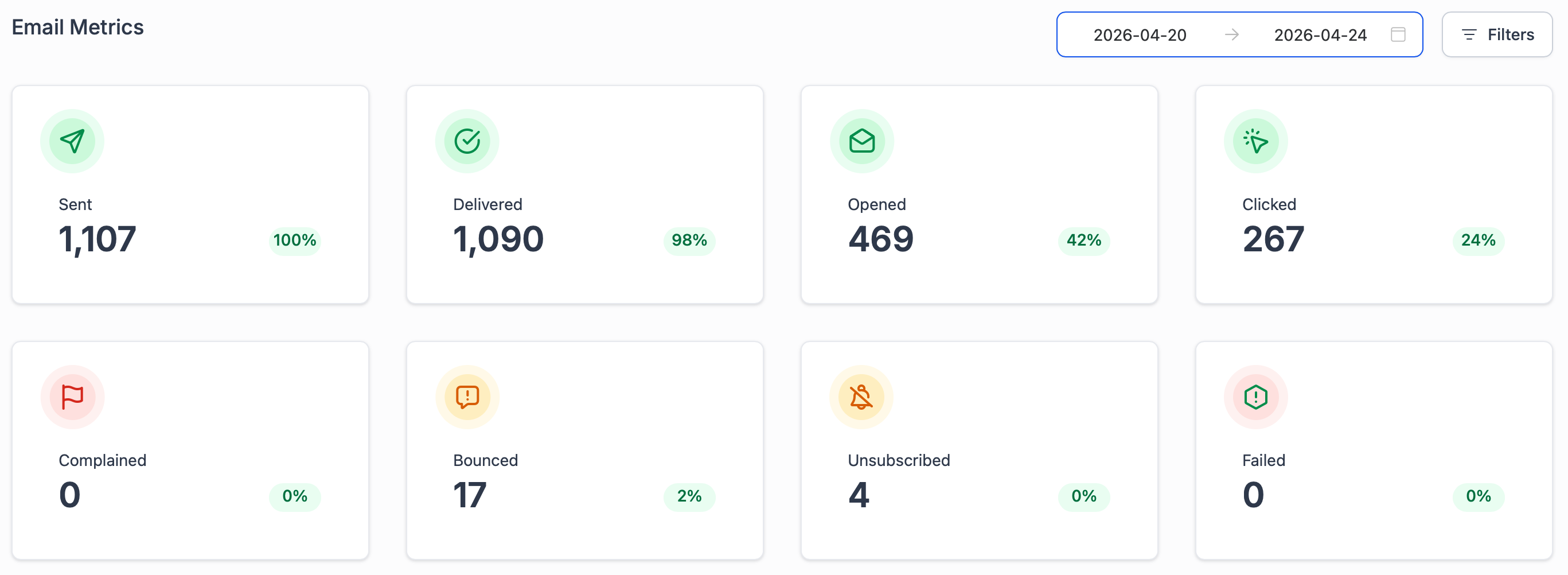
This system brought me 8 booked calls. I turn on the cadence, and it sends 1,107 emails per 5 business days between 20th & 24th April 2026, with 42% open rate and 24% click rate.
Foundation 2: The B2B Sales System and CRM Pipeline
The second foundation addresses the most common growth bottleneck in industrial SMBs. And it is a pipeline that lives in one person's head. When the founder is the only person who knows the status of every deal, the business cannot grow beyond the founder's personal bandwidth.
A complete B2B sales system has these connected components: lead generation, contact sourcing, structured contact database, a CRM pipeline with defined stages, automated email sequence with follow-up, business development layer for strategic accounts, and a reporting dashboard that gives the founder full pipeline visibility from their phone.
This foundation maps what breaks when each component is missing, and what it costs in real terms. It covers how Diamond Hands builds this system inside LeadConnector, including the ICP definition process, CRM configuration, email sequence structure, follow-up automation triggers, and the reporting setup that makes the whole system self-correcting over time.
Read the full article: Why Most B2B Founders Stop Scaling and How a Sales System Finally Fixes It
Foundation 3: Performance Tracking and the KPI Dashboard
The foundation solves the measurement problem. Most industrial SMB founders track activity like emails sent, ads running, and events attended. What they cannot answer is which activity generated revenue and which one is quietly wasting budget.
This foundation is built around one central principle: Money-in is the only metric that cannot be manipulated. Everything else, like pipeline value, open rates, click rates, and ad impressions, is only useful if it explains the path to that number. This foundation introduces a three-layer dashboard framework covering daily, weekly, and monthly review cadences, and maps exactly how each acquisition channel, cold email, paid ads, SEO, newsletter, cold calling, events, social media, and web conversion connects to a measurable revenue output.
Underlying tech of this foundation is tracking infrastructure that makes those numbers reliable: trigger links for click attribution, UTM parameters for GA4 campaign tracking, and the pixel installation sequence for GA4, LinkedIn, Meta, and Google Ads. Without this layer, the dashboard shows numbers nobody trusts.
Read the full article:How B2B Founders Finally See Where Their Money Comes From
What Is Coming Next
The three foundations cover the operational core of a B2B growth system. But a complete industrial B2B playbook also includes more areas that multiply the effectiveness of everything built so far. These are not advanced tactics, they are the amplification layer. And each one is covered in depth in the upcoming articles.
SEO and Online Discoverability (coming soon)
Most industrial B2B companies are invisible online. Not because they have a bad website, but because their website was never built to be found. Google and AI search tools like Perplexity and ChatGPT now answer buyer questions directly, before the buyer ever visits a website. If your business is not in those answers, you are not in the consideration set.
SEO and online discoverability for industrial B2B is not about chasing keywords. It is about building the technical and content infrastructure that makes your business the most credible answer to the questions your ideal clients are asking. That includes Google Business Profile optimization, website technical health, keyword targeting aligned to buying intent, and the content architecture that earns authority over time.
The upcoming article will include two self-assessment checklists. One for traditional SEO readiness and one for AI search visibility. So any founder can audit their current position before deciding where to invest.
Marketing and Branding (coming soon)
Branding is more than aesthetics. It is the system that supports your prospect trusts you more and understands your positioning. Together with marketing, it helps your prospects to reply to your email, click your ad, or book a call, before they have ever spoken to you.
For industrial B2B companies, marketing and branding cover positioning, content framework, visual identity, and visual hierarchy, and how brand consistency across channels affects conversion at every stage of the funnel. A company with good marketing usually outperforms a company with a strong product and weak marketing, because trust is built before the sales conversation starts.
The article will cover how Diamond Hands approaches brand architecture for industrial companies and how to build a content plan that supports the buyer journey without requiring a full marketing department.
Paid Advertising (coming soon)
Paid advertising is the fastest way to generate qualified traffic, and the fastest way to burn budget if the foundation is not in place first.
B2B paid advertising for industrial SMBs covers the full ad strategy: audience targeting, pixel setup and event configuration, creative strategy for cold and warm audiences, retargeting logic, and performance monitoring that connects spend to pipeline entries rather than impressions. The article will also cover the difference between brand awareness campaigns and direct response campaigns, and why running both simultaneously with different success metrics is what separates companies that scale from those that spend.
The coming article includes a deep dive into the ad manager dashboard available inside LeadConnector, and how to use it alongside Meta Ads Manager and LinkedIn Campaign Manager for a unified view of paid performance.
AI and Automation (coming soon)
AI is the most discussed topic in B2B sales and marketing right now, and the most misunderstood. Most founders either ignore it entirely or try to automate everything at once and break the human elements that were working.
The coming article on AI and automation in B2B will cut through the noise. It covers the practical workflows available inside LeadConnector today: AI-assisted lead qualification, automated conversation handling, voice AI agents that work outside office hours, and workflow automations that reduce manual effort across the entire growth system without removing the human judgment where it matters.
Beyond the operational layer, the article covers theoretical use cases for AI in industrial B2B that are already being deployed by early adopters: AI-assisted hiring screening, training, maintenance scheduling support, and customer support automation. Not as a future projection but as systems that exist and can be built now.
How the Pieces Connect
Reading any one of these articles in isolation gives you one piece of the system. Reading them in sequence gives you the architecture overview.
The email system generates contacts and conversations. The sales system turns conversations into a tracked pipeline. The performance dashboard tells you which channels are working and where the system is leaking. SEO and branding build the inbound layer that reduces the cost of outreach over time. Paid ads accelerate the channels that are already converting. AI and automation reduce the manual effort required to run all of it.
None of these layers replaces the others. A company with great SEO but no follow-up system loses leads at the pipeline stage. A company with great ads but no tracking cannot tell whether it is time to scale or improve its strategy first. A company with a great CRM but no inbound presence depends entirely on outbound for growth.
The complete B2B marketing framework is all connected, measured, and continuously improved. That is what Diamond Hands builds, for industrial companies that are ready to generate more deals.
Ready to improve?
Free 20-minute conversation with Diamond Hands founder Ing. Michal Pelda.
No pitch, no generic deck, a real check of your specific setup and you leave with a clear picture of what your system could be doing.


