

Why Most B2B Founders Stop Scaling and How a Sales System Finally Fixes It
The Spreadsheet That Runs the Business
Why Disconnected Pieces Never Add Up to Growth
What a Complete B2B Growth System Actually Looks Like
Component 1: Lead Generation and Contact Sourcing
Component 2: The Contact Database
Component 3: CRM and Sales Pipeline
Component 4: Follow-Up Automation
Component 5: Business Development and Outreach Strategy
Component 6: Analytics and Pipeline Reporting
How Diamond Hands Builds This System
Where Most B2B Sales Systems Break And What It Actually Costs
The Spreadsheet That Runs the Business
It is a Tuesday morning. A fabrication shop owner opens Outlook. Three client emails, one invoice question. Normal start to the day. Then he gets to the sent folder. A prospect from three weeks ago. No follow-up sent. No reply received. Just silence, because nobody remembered to check.
He opens a spreadsheet titled "Leads Q2", 57 rows, last updated six weeks ago, statuses ranging from"interested?" to "call again". He meant to follow up on most of them. He just never had a system that made it smooth and reliable.
By noon, two new enquiries arrived through the website contact form. Both will sit unread until end of the week. The third came in as a LinkedIn message, seen, not answered, now buried under messages.
This is not a strategy problem. It is a system problem. And it is the most common growth bottleneck in industrial B2B companies today.
Why Disconnected Pieces Never Add Up to Growth
Most industrial SMBs are not starting from zero. They have some outreach running, some kind of CRM (or a spreadsheet that acts like one), and a sales process that works, when the founder personally drives it.
The problem is that none of these pieces talk to each other. The email outreach does not update the pipeline. The pipeline does not trigger follow-ups. The follow-ups depend on the founder's memory. And the moment the founder gets busy, which is always, the entire system quietly stops working.
Companies using a properly configured CRM are up to 8 times more likely to exceed sales targets than those operating without one.
The gap is not effort. Industrial SMB founders work harder than almost anyone. The gap is architecture, the way the components of a B2B sales system are connected, sequenced, and automated so that growth does not depend on one person being everywhere at once.
Every component covered in this article feeds into the next. When one is missing or disconnected, the whole system underperforms, not because of bad strategy, but because the structure was never built to hold it.
What a Complete B2B Growth System Actually Looks Like
A complete B2B sales system has six components. Each one does a specific job. Each one depends on the others to deliver its results. Here is what each component does, and what it costs when it is missing.
Component 1: Lead Generation and Contact Sourcing
Every growth system starts here. Without a consistent, repeatable way to bring new contacts into the sales process, everything downstream runs dry. It does not matter how good your CRM is or how well your follow-up sequences are built. If new contacts stop coming in, the system starves.
Most industrial SMBs source leads the same way. It's a combination of referrals, industrial fairs, LinkedIn searches, and a cold emailing every few months when the sales pipeline looks thin. None of these are wrong. The problem is that none of them are powered by a system. Referrals are passive. Industrial fairs aren't combined with nurturing techniques. LinkedIn searches are manual. Sporadic campaigns create pipeline spikes followed by silence.
A functioning lead generation component solves this by making contact sourcing continuous and targeted. That starts with defining your Ideal Customer Profile (ICP) the specific company size, sector, geography, and decision-maker role that describes your best clients. Without this definition, sourcing is guesswork. With it, every method you use, contact research, LinkedIn outreach, industry directories, technical fair's company lists, web scraping, is pointed at the same target.
The sourcing method matters less than the consistency. What breaks most SMB pipelines is not choosing the wrong channel. It is running outreach in bursts instead of at a sustainable daily volume that keeps contacts flowing into the system every week, not just when the time allows it.
Here is a good example I wrote. It is a detailed breakdown of how the email outreach component of this system works in practice, read our article on building an email lead generation system for SMBs.
Component 2: The Contact Database
Every contact your business has ever spoken to, enquired from your website, received an email from, or interacted with on WhatsApp and social media is a commercial asset. Most industrial SMBs have this data scattered across three or four places, an old CRM, a Outlook inbox, a spreadsheet, a business card stack on the desk.
A contact database is not just a list. It is a structured record of every relationship your business has, segmented by status, industry, and engagement history. When it is clean and centralized, it powers every other component. When it is chaos, it silently kills follow-up consistency.
Component 3: CRM and Sales Pipeline
This is the nerve centre of the system. A CRM pipeline translates every contact into a deal stage, from first contact through to closed won or closed lost. Every interaction is logged. Every stage transition is tracked. Every stuck deal is visible.
The most important function of a CRM in an industrial SMB context is not software, it is seamless usage. At any moment, the founder or sales manager should be able to see:
Which contact is the closed to be won
How many active conversations are in progress
Receive automatic SMS or email alerts for every opportunity that has not been contacted in the last 7 days.
Without this visibility, sales can be chaos. With it, sales becomes a managed process.
Diamond Hands builds and configures all client pipelines inside LeadConnector, where every contact, email interaction, call log, and pipeline stage is connected in a single view, accessible from any device, including mobile.
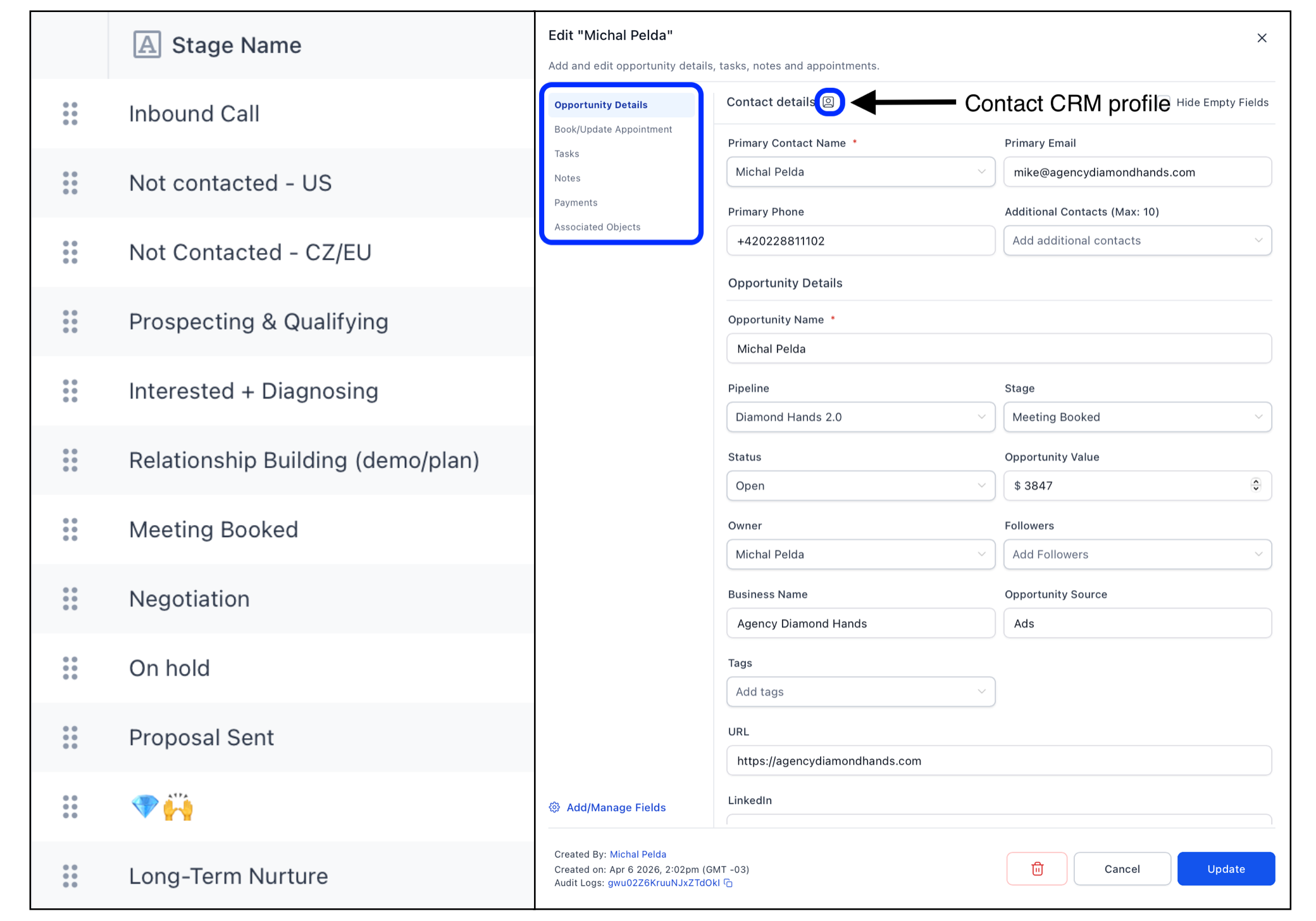
Component 4: Follow-Up Automation
This is the component that breaks most often, and costs the most money when it does.
In B2B sales, a sales representative often needs to make three or more touchpoints with a prospect before a deal negotiation starts. In other words, multiple follow-ups and ongoing contact are commonly required to move the sale to completion.
Most SMB outreach stops at one or two. Not because the founder does not want to follow up. Because following up on 50 active contacts manually is unmanageable alongside running a production floor or managing client order.
Follow-up automation means that every contact in your pipeline receives a defined sequence of touchpoints based on their status and behaviour, without anyone having to remember to send them. If a prospect does not reply to the first outreach email, a follow-up goes out automatically on day four. If they open the follow-up but do not respond, their status updates in the CRM and a task is created for a phone call.
Meanwhile, they began seeing targeted ads designed for their segment. They could then engage with marketing content to prepare for communication.
The system does not replace the human conversation. It aims to improve the salesman work. It ensures more nurturing and that no conversation is accidentally abandoned before it has had a real chance.
Component 5: Business Development and Outreach Strategy
Business development in an industrial SMB context is broader than lead generation. It covers how you position yourself to enter new market segments, how you build partnerships with complementary suppliers, and how you pursue strategic accounts that are too important to leave to an automated sequence.
Most founders treat business development as an activity they do when they have time. The result is that it happens reactively, when the pipeline looks thin, rather than proactively as a continuous motion.
A structured BD component includes a defined list of target accounts, a relationship-building cadence for each, and a clear separation between mass outreach (handled by the automated system) and strategic outreach (handled personally with a defined approach and timeline).
A structured BD component includes a defined list of target accounts, a relationship-building cadence for each, and a clear separation between mass outreach handled by the automated system and strategic outreach handled personally with a defined approach and timeline. Read more how these two fit together within an overall outreach strategy.
Component 6: Analytics and Pipeline Reporting
None of the above is improvable without measurement. The final component of a functioning B2B growth system is a sales pipeline KPIs and reporting that answers three questions every week:
How many new deals were closed?
How many new contacts entered the system?
Where are deals get stuck and why?
Without this data, every decision about outreach volume, follow-up timing, and BD prioritization is based on instinct. With it, the system becomes self-correcting, you can see what is working and scale it, and see what is failing and fix it before it costs pipeline opportunities.
How Diamond Hands Builds This System
When Diamond Hands engages with an industrial SMB, the starting point is always preparation, building the contact list, setting up the outreach campaign, and synchronizing marketing support so that every engaged contact is nurtured at the same time. The sales pipeline becomes the central workspace for tracking both relationships and revenue. The most valuable contacts receive personal attention. Every other contact is approached through a structured daily cadence.
The build process follows a structured sequence:
ICP definition and contact database. We define the right client and build new or validate the initial contact list against that profile. No outreach goes out until the targeting is confirmed.
CRM configuration. We build the CRM custom fields and pipeline stages to match the actual sales process, not a generic template. Every stage has a purpose, and key stages are accompanied by automation triggers.
Email outreach sequences. First introduction, second follow-up, third open-end exit. Manual and automated workflows, marketing strategy to support the outreach, and reply detection that stops the sequence automatically when a prospect engages. Read more about the system that allow this type of outreach sequence: Why Industrial Companies Are Still Sending Sales Emails From Outlook And What It's Costing Them.
Follow-up automation workflows. Beyond email, we configure task triggers, SMS or email reminders, pipeline stage transitions, and other CRM events that activate based on prospect behavior, not a fixed day in the calendar.
BD strategy layer. We identify the top strategic accounts that deserve personal outreach and build a separate, founder-led approach for those relationships.
Reporting dashboard. 24/7 pipeline monitoring that gives the founder complete freedom to check in when ready, all visible in a single dashboard, accessible from any device including mobile.
The system works regardless of what you sell. Whether you run a technical e-shop, rent industrial equipment, manufacture steel components on demand, or sell complex engineering solutions with long sales cycles, the architecture is similar and requires just customization. What changes is the ICP, the outreach angles, and the pipeline stages. The engine and its components underneath stays more or less consistent. This engine is mostly operational within 5 to 10 business days.
Where Most B2B Sales Systems Break And What It Actually Costs
Understanding the architecture is useful. Understanding what breaks and what it costs is what makes founders act.
Here are the five most common failure points in industrial SMB growth systems:
The pipeline lives in one person's head. When the founder is the only person who knows the status of every deal, the business cannot grow beyond the founder's capacity. One holiday, one illness, one busy production month, and the pipeline freezes or gets in trash.
Follow-up stops after the first contact. A single email to a prospect who has never heard of you is not an outreach strategy. It is a lottery ticket. Without automated follow-up, most of the budget and time spent on outreach is wasted on contacts who needed one or two more touchpoint to engage.
The CRM is treated as an admin tool, not a sales tool. If your CRM is only updated after a deal closes, it is not a sales tool. It is an archive. A functioning CRM is updated in daily operation by automation triggers, manul notes, voice recording from the last call, and gives you a live view of where every deal stands.
Lead generation runs only when the pipeline looks empty. A system that only activates under pressure is not a system. It is a panic response. By the time a new campaign generates qualified conversations, weeks have passed and revenue has already been missed. Lead generation must run continuously and can slow down only after reaching a defined volume in the pipeline.
Business development is reactive, not proactive. Waiting for the right opportunity to approach a strategic account is not a strategy. The right time is always now, with a structured approach and a defined relationship-building cadence.
Is Your Growth System Actually Working?
Easy Self-Assessment:
These five questions reveal whether you have a connected system or a collection of disconnected activities.
Do you know, right now, how many active sales conversations are in progress and at what stage each one is?
Does every new contact in your database automatically receive a follow-up if they do not respond to the first outreach?
Is your CRM updated in real time, or only when a deal closes or fails?
Is your outreach running continuously at a defined daily or weekly volume, or only when the pipeline looks empty?
Do you have a structured approach to your top strategic accounts, separate from your mass outreach campaigns?
If you answered NO to two or more, your growth is not stuck because of the market, the competition, or your product. It is stuck because the system that should be running sales is either broken or not built yet.
The good news is, that every single one of these gaps is fixable. None of them require hiring a full-time sales team. All of them can be addressed with the right architecture and the right automation.
Ready to improve?
Free 20-minute conversation with Diamond Hands founder Ing. Michal Pelda.
No pitch, no generic deck, a real check of your specific setup and you leave with a clear picture of what your system could be doing.


